Showing posts with label ibaan. Show all posts

Friday, March 4, 2011

Grilled Tilapia

Grilled Tilapia with kimchi on plate.
Grilled tilapia or inihaw/binanging tilapia usually takes center table for most of men's "conferences". This has been another "everyone's favorite" since time immemorial. Aside from the fact that it's easier to prepare, it also takes shorter time on grill before it reaches the plate. And again, a sizzling dip will provide the boost on its meat juice.

When grilling tilapia, scales were scaled off the skin. They are left intact so as to protect the meat from being directly torched by coal fire. Thus, bitter taste is avoided. You can allow the scale to burn outside, yet meat juice are kept inside. You even see it flow down your fingers when you take a bite of them.

Of course, tilapia need to be cleaned thoroughly. Internal organs and gills must be removed. This, again, will spare your grilled tilapia from the wrath of bitterness. We're talking about grilled tilapia. So when placed on grills, constant air is needed to keep the coal on fire, and to keep smoke from swallowing them. Smoke kills the natural scent of tilapia. The same thing goes with other grilled foods. And for intrinsic taste, salt or ready-mix seasoning can be rubbed around it.

A sizzling dip provides boost on its meat juice.
A medium sized tilapia can be bought at P50.00 - P80.00 per kilo. Large ones are usually pegged at P120.00 and above. And if you want numbers, then you can try the small ones, of course at lower price.

Moniker And Character

Tilapia (pronounced /tɨˈlɑːpiə/ ti-LAH-pee-ə) is the common name for nearly a hundred speciesof cichlid fish from the tilapiine cichlid tribe. Tilapia inhabit a variety of fresh water habitats including shallow streams, ponds, rivers and lakes. Historically they have been of major importance in artisan fishing in Africa and the Levant and are of increasing importance inaquaculture (see tilapia in aquaculture). Tilapia can become problematic invasive species in new warm-water habitats, whether deliberately or accidentally introduced but generally not in temperate climates due to their inability to survive in cool waters, generally below 60 °F (16 °C).

The common name tilapia is based on the name of the cichlid genus Tilapia, which is itself a latinization of thiape, the Tswana word for "fish". Scottish zoologist Andrew Smith named the genus in 1840.

Tilapia go by many names. The moniker "St. Peter's fish" comes from the story in the Christian Bible about the apostle Peter catching a fish that carried a coin in its mouth, though the passage does not name the fish.[3] While the name also applies to Zeus faber, a marine fish not found in the area, a few tilapia species (Sarotherodon galilaeus galilaeus and others) are found in the Sea of Galilee, where the author of the Gospel of Matthew accounts the event took place. These species have been the target of small-scale artisanal fisheries in the area for thousands of years. In some Asiancountries including the Philippines, large tilapia go bypla-pla while the smaller types are just tilapia.


Friday, February 25, 2011

Sinaing Na Tulingan

Sinaing na tulingan en core.
Platillo Ligero

Another old favorite that never run out of popularity is sinaing na tulingan. For centuries, the way it is being cooked remains. The cooking procedures dates back during Spanish time and has survived up to this modern times to grace our plates with elegance.

Basically, sinaing na tulingan is made of tulingan itself, tamarind, salt and tap water. Stuffed in a pot, just let them simmer for around 30 - 40 minutes, depending on the texture of tulingan that you wish to achieve. Banana leaves are often placed between layers so as not to break them when taken out of the pot. Besides, banana leaves add heavenly scent. For longer life, the pot is kept on fire until the sauce dries up, until it sipped into the fish.

They are best served with tomatoes and, of course, onions -that is, if your an aphrodisiac.


Grilled Native Chicken

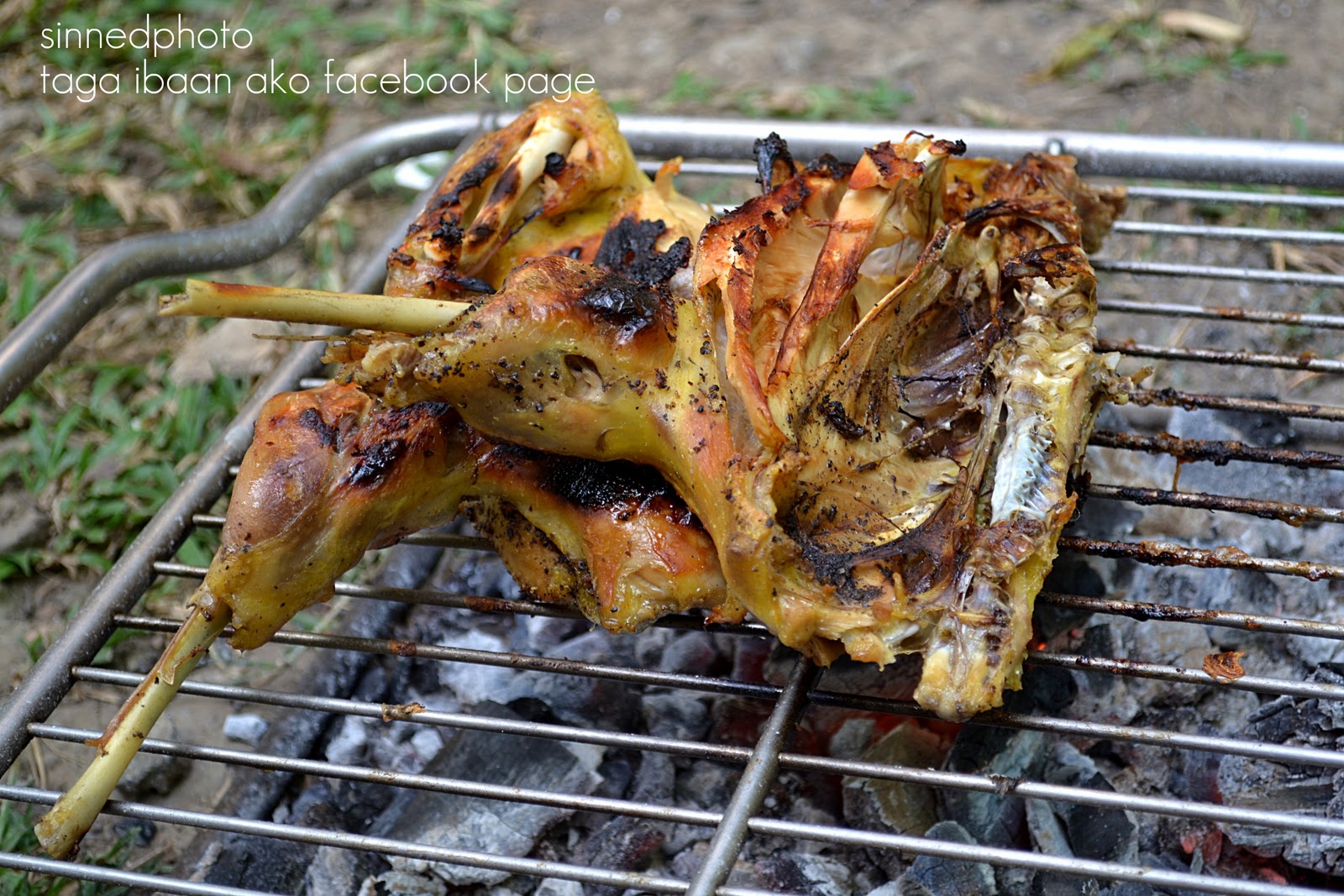
Smoking scent of native chicken (tagalog na manok) on grill.
By Platillo Ligero

Growing up, I was introduced to native chicken (tagalog na manok) as the best and main meat ingredient for tinola. Every time we go to countryside, you'll find them running around at the backyard of every house. And by night fall, they nest the darkness out at tree branches where they take a half-baked nap. Unknowingly, that's how they can be easily trapped. The following day, they end up on a pot teeming with ginger, black pepper, onion, water and young chili leaves. This is then best sipped with yellowish sabaw.

Aside from tinola, native chickens are also often featured with all time favorite lugaw and arroz caldo. Again, with the usual seasoning ginger and others. And is best prepared during rainy days. Sick? Our folks would have this our bedside.

Dip on the side will be great to compliment the meat.
This time, native chicken went grilled! And I treated myself with this. Thanks to birthday boy Allan if Brgy. Coliat I, Ibaan, Batangas.

With my hand springing with and army of fork, I went on slicing this sweet native chicken. Meat juice remained in between meat shreds, aroma filling the air with every cut. There's nothing extra ordinary however. Before hitting the grill, the native chicken was first boiled with some seasoning until tender. It shouldn't stay that long on fire to keep the meat intact with bones. You can keep it soaked with seasoned sabaw for a while before deciding on grilling them. And when you do, just keep on turning once in a while so a control the heat it receive. That is not to harden much of the meat and to keep its dignity and tenderness.

Of course, dip on side will do more of the trick.


Sunday, February 6, 2011

Tahong Na Biyaheng Bicol (Bicol Express)

By Platillo Ligero


Bicol Express (Bikol: Sinilihan) is a popular Filipino dish which was popularized in the district of Malate, Manila but made in traditional Bicolano style.It is a stew made from long chilies (siling mahaba in Tagalog, lada panjang in Malay/Indonesian), coconut milk, shrimp paste or stockfish, onion, pork, and garlic. It is said to have evolved from gulay na may lada, another Bicolano dish which is nowadays also presented as one of the many variants of Bicol Express.


One of the favorite variants for Bicol Express are sea foods that include tahong, alimango (crabs) and hipon (shrimp). Others would also use pork meat. But since seafoods are expensive, medium sized tahong and hipon will do.


Preparing this one follows the usual ginataan dish. Recipe include gata (coconut milk) spices like luya (ginger) and sili (chili), garlic,onion, and salt. Take note, since this is Bicol Express, it should be a sizzler. So choose chili that explodes in the mouth.Sometimes, seafoods are first sautéed  garlic, ginger and onion, followed by the pouring of coconut milk. Others may choose have them all in one batch until it simmer. Also, they may also be pina-iga or with sabaw.


What ever and however Bicol Express is prepared, it doesn't matter. Just make sure it's one hot sizzling bite.


(Thanks to ours friends in Brgy. Coliat 1 for serving us with this during one of my visits in the place.)


Saturday, January 22, 2011

Native Chicken (Tagalog Na Manok) On Lugaw

By Platillo Ligero

Lugaw is one of the favorites of Batanguenos, specially during rainy days. When one feels cold, lugaw takes on everyone's saucer. It comes in variety like that of arroz caldo with beef (either with meat or internal organs as others would have or call it in Manila). We also have lugaw with boiled egg, or just plain lugaw.

Now this one is special. Instead of the traditional ones, this lugaw includes tagalog na manok (Philippine native chicken) as its main feature. And this lugawan tops any other eatery in Ibaan, Batangas. Aling Norma and Kuya Alex's Lugawan has become a household name in the area being the one and only with such creation. Located at van terminal down town, they operates from 7:00pm to 3:00am.

You might want to give it a try. You won't be disappointed.


Laing

By Platillo Ligero

Laing has come a long way. Basically, this smoking menu consists of gabi leaves and shoots, coconut milk, chilli, salt, black pepper, ginger, garlic, and onion. Its preparation varies from one place to another. Some it have it concocted by sauteing ginger, garlic and onion first followed by pouring coconut milk when they turned golden brown. Gabi leaves and shoots come last when the mixture reached its boiling point. Others would just  have all of the ingredients together on a pot until gabi leaves and shoots soften.

Others like it hot and sizzling, particularly those from Bicol area, while some want them the old-fashioned-way. With its variety, one could hardly recognize which one is authentic. But whatever they may be, laing remains of the most liked delicacies around. And the Municipality of Ibaan in the Province of Batangas wish not to be left behind.